Philosophy
Our philosophy is grounded in intellectual courage, perseverance, loyalty, fairness, independent thought, and the responsibility to transform knowledge into meaningful action. The following twelve principles reflect the values that guide how we conduct research, choose problems, support one another, and pursue long-term scientific impact.

Why We Work in Medicine
Our interest in medicine did not begin with an abstract methodological question. It began with a desire to understand the human body, the pain and frustration caused by sports injuries, and the possibility of using quantitative knowledge to improve people’s lives.
At the age of fifteen, while competing in athletics, Marcos Matabuena became fascinated by how training, fatigue, physiology, and individual variability shape human performance. At around the same time, a serious sports injury prevented him from continuing the activity he loved for nearly two years. The experience led him to think more deeply about injury, recovery, and human movement, and to explore these questions from a biomechanical and quantitative perspective.
This curiosity eventually led him to study Mathematics. During his early academic training, he developed methods for estimating maximal oxygen uptake, modelling the relationship between training and fatigue, and identifying physiological thresholds through heart-rate variability. These projects were motivated not only by athletic performance, but also by a broader question: how can data help us understand what is happening inside the human body?
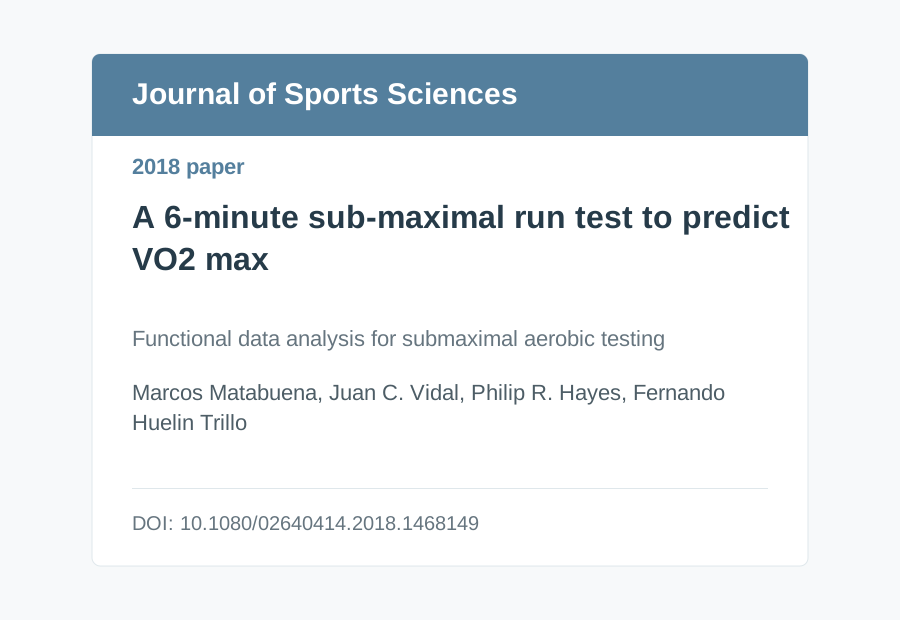
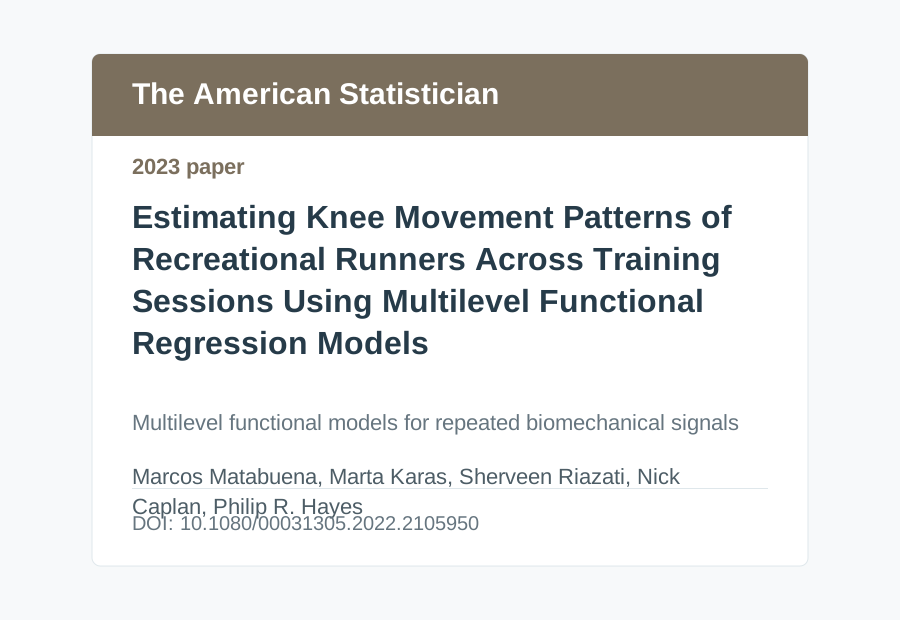
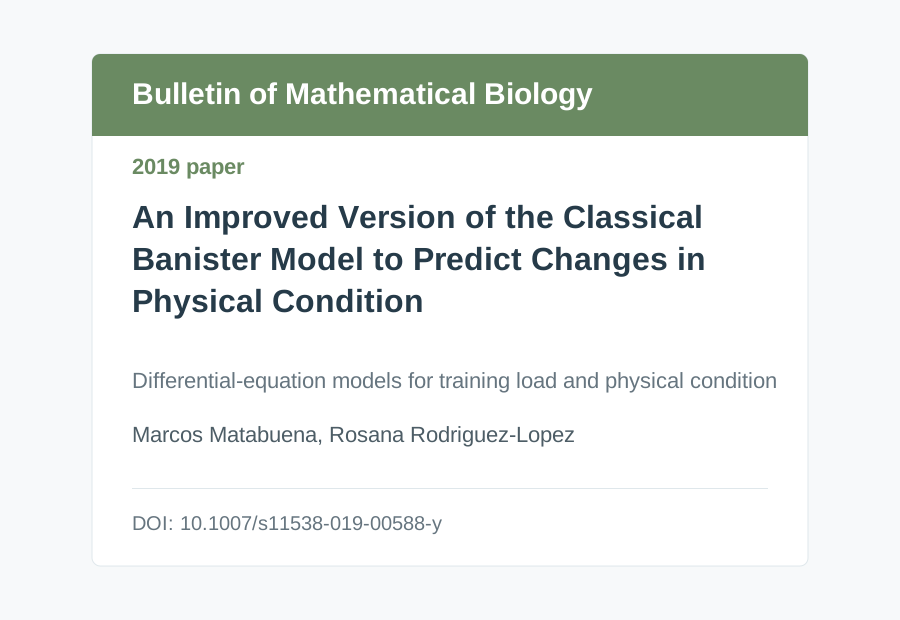
That work revealed a wider scientific opportunity. Data collected continuously from the body can capture patterns that conventional clinical measurements often miss. They can help us understand individual physiology, monitor changes over time, prevent injuries, and design more personalized approaches to health and physical activity. Long before digital health became an established research field, this idea began to shape a scientific path connecting mathematics, statistics, physiology, and medicine.
Over time, the questions became increasingly clinical. How can continuous glucose-monitoring data improve our understanding of metabolic health? How can digital biomarkers help predict disease onset and progression? How should uncertainty be quantified when medical outcomes are curves, distributions, images, networks, or other complex non-Euclidean objects? And how can these methodological advances support better prevention, diagnosis, treatment, and healthcare decision-making?
Digital Biostatistics emerged from this journey. It reflects the conviction that mathematical innovation has its greatest value when it is used to address meaningful biomedical problems arising from the continuous, high-frequency, and multimodal data now collected about human health and behaviour.
Behind every digital signal is a person. Behind every statistical prediction is a decision. And behind every methodological contribution should be the possibility of improving human health.
Our Twelve Principles
1. Deserving Success
“Success is easy to achieve; the difficult part is deserving it.”
— Albert Camus
2. Leadership Through Care
“Treat your soldiers as you would a newborn child, and they will be willing to follow you into the deepest valleys. Care for them as you would your own beloved children, and they will gladly die by your side.”
— Sun Tzu
3. Choosing Meaningful Problems
“Choosing a worthwhile PhD research problem is like choosing a good bride for your son.”
— Vladimir Arnold
4. The Courage to Act
“To recognise what is right and fail to act upon it is cowardice.”
— Confucius
5. The Value of an Idea
“A poor person’s advice, however sound it may be, is never accepted.”
— Miguel de Cervantes
6. Knowledge From Within
“Only the knowledge that comes from within is true knowledge.”
— Socrates
7. Lifelong Perseverance
“There are those who fight for a day, and they are good. There are others who fight for a year, and they are better. Some fight for many years, and they are very good. But there are those who fight throughout their entire lives: they are the indispensable ones.”
— Bertolt Brecht
8. Remaining in Love With the Work
“One should always be in love. That is why one should never marry.”
— Oscar Wilde
9. Finding a Way
“Those who want to do something find a way; those who do not find an excuse.”
— Arab proverb
10. Working in Obscurity
“Whoever studies for ten years in obscurity will eventually become universally known.”
— Chinese proverb
11. The Courage of New Ideas
“A man with new ideas is considered mad until his ideas succeed.”
— Mark Twain
12. Choices Define Us
“It is not our abilities that show who we truly are, but our choices.”
— J. K. Rowling
These principles did not emerge in isolation. They were shaped by personal experience, years of scientific uncertainty, the example of exceptional mentors, and the conviction that ambitious research must remain connected to problems that truly matter.
The Mentorship Behind Our Scientific Purpose
Five years ago, one of my most important mentors—perhaps the person who has influenced my life the most, aside from my mother and one of my high school teachers—told me:
“Marcos, if you truly focus, you have the potential to make a meaningful impact on medicine and become an influential researcher.”
Three years later, he gave me another piece of advice that has stayed with me ever since:
“Many statisticians are proud of the impact of their work, but their contributions remain largely unknown within the biomedical community or have limited practical value. You have a gift. You need to develop models that truly matter.”
Four months ago, he reminded me once again that, if I remain focused, the sky is the limit. His words have deeply shaped my scientific ambition, my understanding of mentorship, and the way I support my team. They have taught me that mathematical sophistication is not enough on its own. The most valuable methodological research begins with important biomedical questions and leads to tools that researchers, clinicians, and patients can genuinely benefit from.
Our central ambition is to build on the glucodensity framework and related statistical methodologies to contribute to major advances in diabetes research and personalized nutrition. We aim to develop methods that are not only mathematically innovative, but also capable of changing how diseases are understood, monitored, predicted, prevented, and treated.
Manifests that Inspire Us
A Personal Journey Through Biostatistics, Artificial Intelligence, and Change
In this personal essay, Marcos Matabuena reflects on his scientific journey, the influence of sport and triathlon, the importance of interdisciplinary thinking, and the lessons he learned from mentors, collaborators, and major figures in science.
Read “My Thoughts on the Future of Biostatistics in the Era of Artificial Intelligence”
Biostatistics, Artificial Intelligence, and the Purpose of Scientific Work
This reflection considers the role of biostatistics in the age of artificial intelligence through the story and ideas of Yinchao.
Read “Biostatistics in the Age of Artificial Intelligence”
A Practical Guide to Research (in Chinese)
Jianqiao Wang’s (Tsinghua University) guide offers reflections on doctoral training, scientific communication, intellectual openness, asking meaningful questions, developing data intuition, and learning from colleagues rather than viewing them as competitors.
Sport, Resilience, and the Long-Distance Mindset
We see scientific life as a marathon—or, more broadly, as an endurance sport. Meaningful research requires patience, discipline, repetition, resilience, and the ability to continue when progress is slow or uncertain. Athletes rarely succeed because of a single extraordinary moment. Their achievements are built through years of training.
Rafael Nadal and his coach, Toni Nadal, represent this philosophy particularly well.